
InfraGov 2.0 is here!
Better infrastructure starts with better governance
InfraGov 2.0 is the World Bank Group's framework for assessing how well a country manages public investment — across 16 dimensions and 119 indicators, module by module, from a project's first idea to its final review.
Overview
What is InfraGov 2.0?
Public investment management — PIM for short — is how governments choose, deliver, and look after the infrastructure their citizens rely on: roads, schools, power, water. When it's done well, money goes further and projects deliver. When it's done poorly, costs spiral and benefits never arrive.
InfraGov 2.0 is a structured way to see where a country stands. It brings together the best of the tools that came before it — the World Bank's 8 Must-Haves and InfraGov 1.0, the IMF's PIMA, PEFA, and the OECD's infrastructure toolkit — into one modular, problem-driven framework. It assesses the maturity of a country's PIM system across 16 dimensions, scores each against clear benchmarks, and points the way toward practical reform.


WHY
Why it matters
Strong infrastructure governance is a fiscal and developmental imperative, not a technical nicety. Yet for years, assessment tools struggled with the same gaps: results that couldn't be compared across countries, advice that named problems without showing how to fix them, little evidence of real impact, and a scope that lagged behind new priorities like climate and decentralisation.
InfraGov 2.0 was built to close those gaps.
- •Structured and comparable — standard benchmarks mean results hold up across countries and over time.
- •Modular and cost-effective — assess everything, or just the areas that matter most right now.
- •From “what” to “how” — every finding connects to practical reform guidance, not just a diagnosis.
- •A living framework — designed to grow with new evidence, tools, and global priorities.
Framework
16 dimensions, three thematic areas
The framework spans 16 dimensions, grouped into three areas. The first eight are the 8 Must-Haves — the essential, non-negotiable functions every well-run public investment system performs, following a project from its first idea to its final review. Three cross-cutting dimensions cover the foundations that hold the whole system together, and five optional special topics tackle today's fast-moving priorities. Countries apply whichever areas fit their needs.
Guidance
Clear policies, regulations, and mandates that define roles and responsibilities across the investment cycle.
Appraisal
Rigorous cost-benefit analysis and feasibility assessment before projects enter the pipeline.
Independent Review
Third-party quality assurance to validate project design, cost estimates, and risk assessments.
Selection
Prioritization and budget allocation based on strategic objectives and evidence of economic value.
Implementation
Active project management to keep delivery on time, on budget, and to specification.
Adjustment
Adaptive management mechanisms that allow course correction when scope, cost, or schedule change.
Operation
Systematic asset management to maximize service delivery and extend infrastructure lifespan.
Evaluation
Post-completion review to assess outcomes, capture lessons, and improve future investment decisions.
Institutional & legal framework
A sound legal hierarchy and a mandated PIM body at the centre of government.
Integrity & anti-corruption
Safeguards against misconduct across the whole project cycle.
Information systems & digitalisation
A single, digital PIM database that powers decisions.
Climate-smart PIM
Building climate mitigation and adaptation into every stage of investment.
Public asset management
Registering, maintaining and optimising public assets over their life.
PIM for PPP governance
Bringing public-private partnerships into one unified appraisal and selection system.
PIM for SOE projects
Aligning state-owned enterprise investment with national oversight.
Subnational PIM governance
Strengthening and coordinating public investment below the central level.
Maturity Levels
A maturity ladder, not a scoreboard
Every dimension is benchmarked on the same four-point scale. It describes a journey of progress — where a country sits in a sequence of development stages — rather than a pass or fail.
Incipient
The need is recognised, but systematic processes aren't yet in place.
Nascent
Foundational structures are emerging, applied unevenly across institutions.
Emerging
Consistent processes and growing capacity, on a credible path forward.
Advanced
Leading practice: fully developed, consistently applied, routinely improved.
Put the framework to work
The InfraGov Dashboard
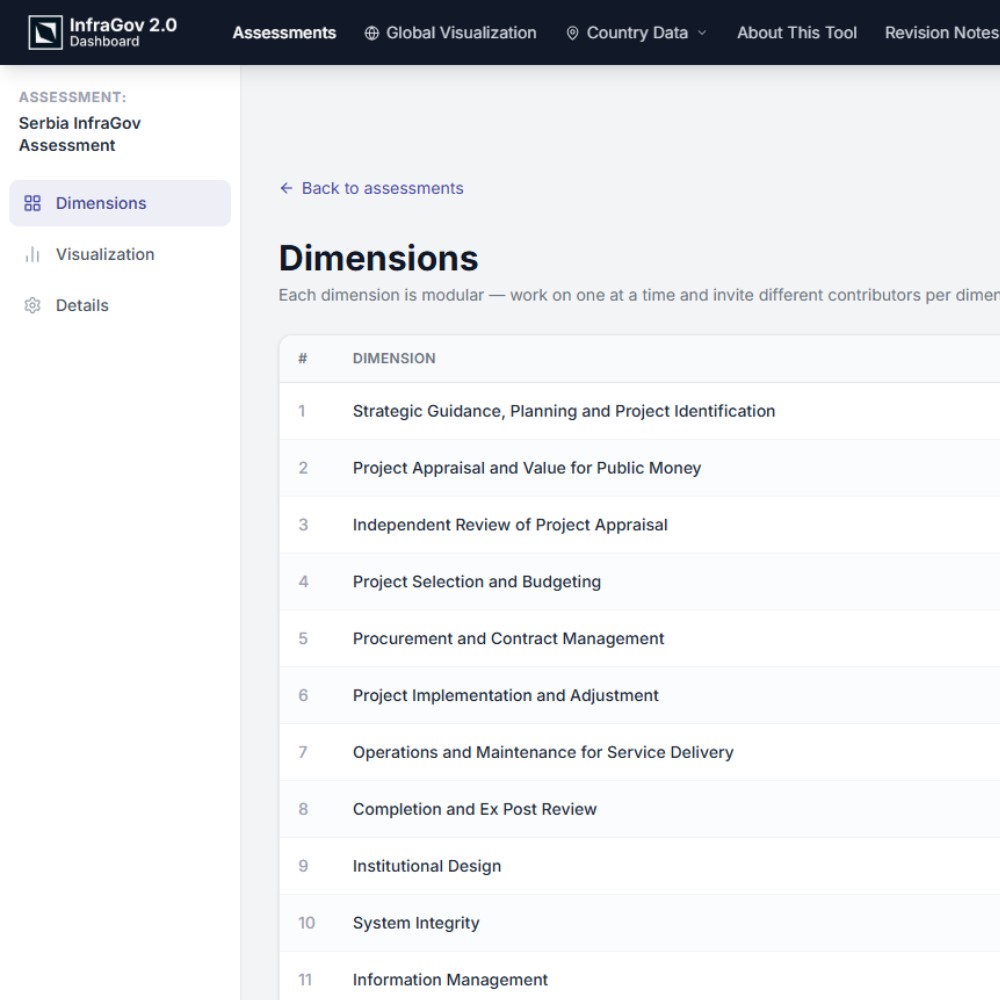
The InfraGov Benchmarking Dashboard lets country teams self-assess infrastructure governance against the InfraGov 2.0 framework, module by module and share validated results once review and quality control are complete.
- •Assess one, several, or all 16 InfraGov 2.0 dimensions
- •Run a specialized assessment, such as a PAG Functional Assessment
- •Save, resume, and version each assessment by its cut-off date
- •Work as a team with flexible read and write permissions
- •Complete review and quality control, then publish a public version